
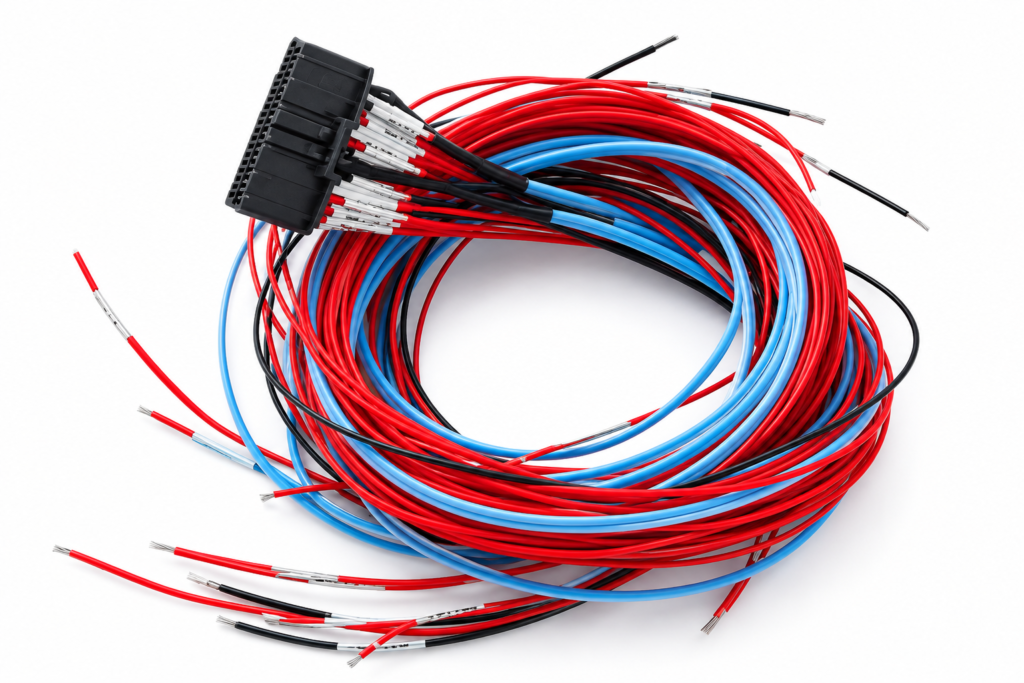
A Discrete Wire Assembly is a customized wiring solution made from individual insulated wires that are assembled with connectors, terminals, or other termination components according to specific electrical and mechanical requirements. Unlike standard cables, discrete wire assemblies can be configured with different wire lengths, colors, gauges, connector types, pin configurations, and termination methods.
Discrete wire assemblies are widely used in electronic equipment, industrial machinery, control systems, automotive electronics, automation equipment, and other applications that require organized and reliable point-to-point wiring.
For OEMs and equipment manufacturers, a custom discrete wire assembly can simplify installation, improve wiring consistency, and reduce the amount of manual wire preparation required during final assembly.
What Is a Discrete Wire Assembly?
A discrete wire assembly consists of multiple individual wires that are cut, stripped, terminated, and organized according to a defined wiring configuration.
Each individual wire can have its own:
- Wire gauge
- Length
- Color
- Insulation
- Terminal
- Connector position
- Pin assignment
- End termination
Depending on the application, a discrete wire assembly may have a connector on one end and individual wire ends on the other, connectors on both ends, or different combinations of terminals and connectors.
This flexibility makes discrete wire assemblies suitable for applications where standard pre-made cables cannot meet the required connection layout.
For manufacturing, the most important information normally includes the wire specification, connector details, pinout, wire length, termination method, and testing requirements.
Key Features of Discrete Wire Assemblies
A custom discrete wire assembly can be designed around the electrical and mechanical requirements of the final equipment.
1. Multiple Individual Wires
Unlike a single jacketed cable, a discrete wire assembly uses individual insulated conductors. Different wires can be arranged according to the required circuit or connector configuration.
For example, an assembly may contain red, black, blue, white, or other color-coded wires to help identify individual circuits.
2. Custom Wire Length
Wire lengths can be specified according to the installation location.
Different wires within the same assembly can also have different lengths when required by the equipment layout.
This can reduce unnecessary wire routing and help simplify installation.
3. Custom Connectors
Discrete wire assemblies can be terminated with various connector housings and contact systems.
Connector selection depends on factors such as:
- Number of circuits
- Pin configuration
- Wire gauge
- Pitch
- Mating interface
- Locking requirements
- Environmental conditions
- Electrical requirements
Connectorized discrete-wire assemblies are commonly available in straight, branched, single-ended, and dual-ended configurations.
4. Customized Pinout
The pinout defines which wire connects to each connector position.
For example:
| Connector Pin | Wire Color | Wire Function |
|---|---|---|
| Pin 1 | Red | Power |
| Pin 2 | Black | Ground |
| Pin 3 | Blue | Signal |
| Pin 4 | White | Signal |
The actual pin assignment should always be defined according to the customer’s electrical design rather than assumed from wire color alone.
A clear pinout is especially important for OEM production because it provides a consistent reference for assembly and electrical testing.
Discrete Wire Assembly Specifications
The exact specifications of a discrete wire assembly depend on the application and customer requirements. The following specifications can be customized during the design and quotation process.
| Specification | Typical Options |
|---|---|
| Product Type | Discrete Wire Assembly |
| Wire Configuration | Single / Multi-wire |
| Wire Gauge | Custom |
| Conductor Material | Copper / Tinned Copper |
| Wire Length | Custom |
| Wire Color | Red / Black / Blue / White / Custom |
| Insulation | PVC / Silicone / TPE / Other |
| Connector | Custom connector |
| Pin Count | Custom |
| Pinout | Customer specified |
| Terminal Type | Custom |
| Wire End | Stripped / Tinned / Crimped / Connectorized |
| Wire Arrangement | Straight / Custom |
| Heat Shrink | Optional |
| Protective Sleeve | Optional |
| Wire Identification | Color coding / Labels / Marking |
| Electrical Testing | Continuity / Pinout / Other required tests |
| Packaging | Custom |
Important: The specifications above describe customizable options rather than fixed specifications for every assembly. The actual wire gauge, voltage rating, current rating, temperature range, connector model, and pin count should be confirmed from the product drawing or engineering specification before publication.
Wire Gauge and Conductor Selection
Wire gauge is one of the most important parameters when designing a discrete wire assembly.
The appropriate wire size depends on factors such as:
- Required current
- Voltage
- Wire length
- Temperature
- Installation space
- Connector compatibility
- Voltage drop requirements
Different circuits within the same assembly may also use different wire gauges.
For example, a power circuit may require a larger conductor while a low-current signal circuit may use a smaller wire.
Therefore, the wire gauge should be selected according to the electrical requirements of the application rather than using one fixed gauge for every discrete wire assembly.
Wire Insulation Options
Wire insulation protects the conductor and helps determine the suitability of the assembly for different environments.
Common insulation materials include:
PVC Wire
PVC is widely used for general electrical and electronic wiring because of its versatility and cost-effectiveness.
Silicone Wire
Silicone insulation provides high flexibility and can be suitable for applications where repeated movement or flexibility is important.
TPE Wire
TPE can provide a combination of flexibility and environmental resistance for selected applications.
Other Insulation Materials
Depending on the application, manufacturers may also offer other insulation materials for high-temperature, chemical, mechanical, or special environmental requirements.
The actual insulation material should be selected based on the required temperature, flexibility, voltage, environment, and connector compatibility.
Connector and Pin Configuration
The connector is another important component of a discrete wire assembly.
A connectorized assembly can provide a defined interface between the wiring assembly and a PCB, electronic module, control unit, sensor, or other equipment.
Connector specifications may include:
- Connector housing
- Number of positions
- Number of rows
- Contact type
- Pitch
- Locking mechanism
- Polarization
- Keying
- Connector orientation
- Wire termination method
For example, commercially available discrete-wire systems can support cable-to-board, cable-to-cable, and cable-to-panel applications, with different wire gauges and connector configurations.
For a custom product, the connector model and pin assignment should be specified before production.
Wire Termination Options
The ends of individual wires can be processed according to the installation requirements.
Common termination methods include:
Crimped Wire Ends
Crimping creates a mechanical and electrical connection between the conductor and terminal or contact.
Stripped Wire Ends
The insulation is removed from the end of the wire so that the conductor can be connected during final equipment assembly.
Tinned Wire Ends
The exposed conductor can be tinned when required by the assembly process or application.
Connectorized Ends
Individual wires can be inserted into connector housings according to the specified pinout.
A single discrete wire assembly can also combine different termination methods on different ends.
Applications of Discrete Wire Assemblies
Discrete wire assemblies are suitable for a wide range of electrical and electronic equipment.
Industrial Equipment
Discrete wire assemblies can be used for internal equipment wiring, control circuits, sensors, actuators, and electrical interfaces.
Pre-assembled wiring can help reduce manual wire preparation during equipment production.
Automation Systems
Industrial automation equipment often contains multiple sensors, controllers, motors, switches, and communication components.
Custom discrete wire assemblies can organize these individual connections and provide repeatable wiring configurations.
Electronic Equipment
Discrete wire assemblies can connect PCBs, electronic modules, displays, switches, sensors, and other components.
Connectorized wiring can simplify installation and maintenance.
Automotive Electronics
Custom wiring assemblies can be used for selected automotive electronic systems, control modules, sensors, and internal electrical connections when the wire and connector specifications meet the application requirements.
Control Systems
Control panels and electrical equipment may require multiple individual circuits with different wire lengths and termination points.
A customized assembly can combine these connections into a controlled wiring solution.
Consumer and Commercial Equipment
Discrete wire assemblies can also be used in appliances, electronic devices, test equipment, and other products requiring organized internal wiring.
Benefits of Using a Custom Discrete Wire Assembly
Simplified Installation
Pre-cut and pre-terminated wires can reduce the amount of manual wiring required during final equipment assembly.
Consistent Wiring
A standardized assembly can help maintain consistent wire lengths, colors, pinouts, and termination methods across production batches.
Reduced Assembly Time
Instead of preparing each wire individually during equipment assembly, operators can install a completed wiring assembly.
Flexible Design
Wire gauge, length, connector, pinout, color, and termination can be configured according to the application.
Easier Maintenance
Color coding, wire identification, and clearly defined connector positions can make troubleshooting and replacement easier.
Discrete Wire Assembly Manufacturing Process
A typical manufacturing process includes several steps.
Step 1: Specification Review
The manufacturer reviews the customer’s drawing, wiring diagram, BOM, sample, connector information, wire specifications, and pinout.
These documents establish the electrical and mechanical requirements of the assembly.
Step 2: Wire Cutting
Individual wires are cut to the required lengths.
If different wires have different lengths, each wire is processed according to the specified cut length.
Step 3: Wire Stripping
The required amount of insulation is removed from the wire ends.
The stripping length should be controlled to ensure proper terminal or connector assembly.
Step 4: Terminal Crimping
When terminals or contacts are required, the prepared wire ends are crimped according to the specified terminal and tooling requirements.
Step 5: Connector Assembly
The terminated wires are inserted into the connector housing according to the defined pinout.
Connector orientation and wire sequence are checked during this stage.
Step 6: Wire Organization
The individual wires can be arranged, bundled, labeled, or protected according to the assembly design.
Optional materials may include:
- Heat-shrink tubing
- Sleeving
- Tape
- Cable ties
- Wire labels
- Protective tubing
Step 7: Electrical Testing
Depending on the product requirements, electrical testing may include:
- Continuity testing
- Pinout verification
- Short-circuit testing
- Polarity checking
- Insulation testing
- Functional testing
The exact testing requirements should be agreed upon before production. Industry manufacturing guidance commonly defines continuity, pinout, and other electrical tests according to the assembly’s design and acceptance criteria.
Step 8: Final Inspection
The completed assembly is inspected for:
- Wire length
- Connector position
- Wire color
- Pinout
- Terminal condition
- Connector locking
- Labeling
- Overall appearance
The finished product is then packaged according to the customer’s requirements.
How to Customize a Discrete Wire Assembly
When requesting a custom discrete wire assembly, providing detailed product information can make the quotation and production process more efficient.
Customers should ideally provide:
1. Wire Information
- Wire gauge
- Conductor material
- Insulation material
- Wire color
- Wire length
2. Connector Information
- Connector manufacturer
- Part number
- Number of positions
- Connector orientation
- Mating connector information
3. Pinout Information
Provide a clear connection table showing:
Connector → Pin → Wire → Destination
This helps prevent incorrect connections during production.
4. Termination Requirements
Specify whether the wire ends require:
- Crimp terminals
- Connector contacts
- Stripping
- Tinning
- Other terminal processing
5. Protection Requirements
Depending on the installation environment, specify whether the assembly needs:
- Heat shrink
- Braided sleeving
- Protective tubing
- Cable ties
- Labels
- Other protection
6. Testing Requirements
If specific electrical testing is required, the test method and acceptance criteria should be defined before production.
What Information Is Needed for a Custom Discrete Wire Assembly?
For an OEM or custom project, a manufacturer can usually start with a drawing, wiring diagram, BOM, pinout, sample, or even a clear product reference photo.
The more complete the information, the easier it is to establish an accurate manufacturing specification.
A useful RFQ package may include:
| Required Information | Purpose |
|---|---|
| Product Drawing | Defines physical dimensions |
| Wiring Diagram | Defines electrical connections |
| BOM | Defines components |
| Wire Specification | Defines conductor and insulation |
| Connector Part Number | Defines mating interface |
| Pinout | Defines wire-to-pin relationship |
| Wire Length | Defines physical configuration |
| Quantity | Defines production requirements |
| Testing Requirements | Defines quality verification |
| Application | Helps determine material requirements |
For projects without a complete drawing, manufacturers may also work from an existing sample, photograph, sketch, or partial specification and clarify the remaining requirements before production.
Why Choose a Custom Discrete Wire Assembly?
A custom discrete wire assembly is useful when standard cables cannot meet the required wiring configuration.
Instead of purchasing individual wires, terminals, and connectors and assembling them manually, OEM customers can receive a completed wiring assembly built according to their specifications.
This approach can provide:
- Custom wire lengths
- Custom connector configurations
- Defined pinouts
- Multiple wire colors
- Customized termination
- Repeatable production
- Easier installation
- Reduced manual wiring
For equipment manufacturers, these advantages can be particularly useful when the same wiring configuration is required repeatedly across production batches.
Custom Discrete Wire Assembly Manufacturer
If you are looking for a custom discrete wire assembly manufacturer, the supplier should be able to work from your drawings, samples, wiring diagrams, BOM, connector specifications, or pinout requirements.
A suitable manufacturing process should include specification review, wire preparation, connector or terminal assembly, inspection, and appropriate electrical testing.
For custom projects, manufacturers may also support prototype development, sample approval, small-batch production, and repeat manufacturing according to the confirmed specification.
Whether you need a simple connector-to-wire assembly or a more complex multi-wire configuration, the final product should be manufactured according to the confirmed electrical and mechanical requirements.
Conclusion
Discrete Wire Assembly provides a flexible solution for applications that require multiple individual wires to be organized and terminated according to a specific design.
Wire gauge, wire length, insulation, color, connector type, pinout, terminal configuration, and protection methods can all be customized according to the application.
From industrial equipment and automation systems to electronic devices and control systems, custom discrete wire assemblies can help simplify installation and provide consistent, repeatable wiring.
If you have a wiring drawing, connector specification, BOM, sample, or product requirements, a custom discrete wire assembly can be developed around your specific application.
Frequently Asked Questions
What is a discrete wire assembly?
A discrete wire assembly is a group of individual insulated wires that are cut, terminated, and organized according to a specified electrical connection and mechanical configuration.
What is the difference between a discrete wire assembly and a cable assembly?
A discrete wire assembly primarily uses individual wires, while a cable assembly may use a jacketed multi-conductor cable or other cable construction. However, the terminology can overlap depending on the manufacturer and application.
Can a discrete wire assembly be customized?
Yes. Wire gauge, length, color, insulation, connector, pinout, terminal, wire-end treatment, protection, and labeling can be customized.
Can different wire gauges be used in one assembly?
Yes, when the connector and application requirements allow it. Different circuits within one assembly may require different conductor sizes.
Can you manufacture a discrete wire assembly from a sample?
In many custom manufacturing projects, an existing sample, photograph, drawing, wiring diagram, or BOM can be used as the starting point for specification review. The exact production requirements should be confirmed before manufacturing.
What testing can be performed?
Depending on the product design, testing may include continuity, pinout, polarity, short-circuit, insulation, or functional testing.