
When electrical wires need to run through equipment, enclosures, or installation spaces, keeping them organized and protected is an important part of the design.
Loose wires can be difficult to route, identify, and manage, especially when an assembly contains multiple conductors with different connection points. A custom sleeved wire harness provides a more organized solution by combining electrical wires, connectors, termination points, and protective sleeving into one assembly.
For OEM equipment manufacturers, the right wire harness needs to do more than connect electrical components. It should also fit the available space, follow the intended routing path, and provide the protection required by the operating environment.
In this guide, we will explain how a custom sleeved wire harness is constructed, what specifications matter when ordering one, how protective sleeving is selected, and what to consider when working with a wire harness manufacturer.
What Is a Custom Sleeved Wire Harness?
A custom sleeved wire harness is an electrical wiring assembly that combines multiple wires or cables with connectors, terminations, and an outer protective covering.
The protective sleeve helps organize the wire bundle and can provide an additional layer of protection against certain types of mechanical wear, depending on the sleeve material and construction.
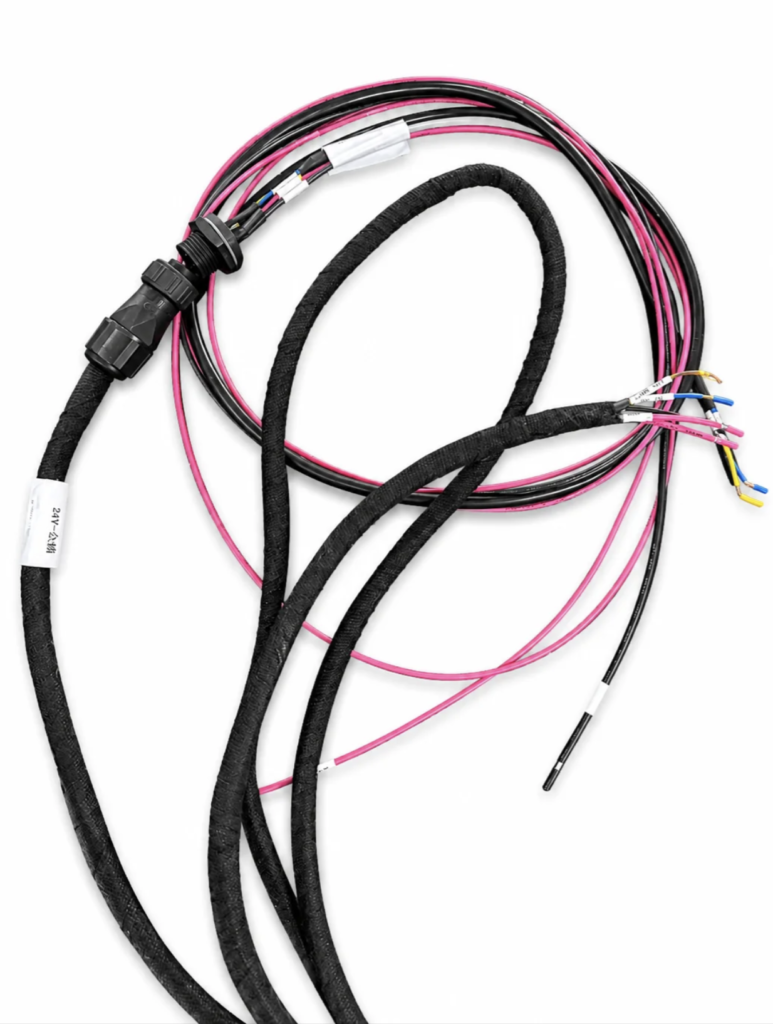
The assembly shown in the product image features a circular connector, multiple colored wires, black protective sleeving, and several individual wire ends. This type of configuration can be customized to match the connection layout and installation requirements of specific equipment.
Depending on the project, a custom sleeved wire harness may include:
- Multiple insulated electrical wires
- Circular or other specified connectors
- Individual wire branches and termination points
- Braided or fabric-style protective sleeving
- Heat-shrink tubing and transition protection
- Wire labels and identification markers
- Custom cable lengths and routing configurations
The exact construction depends on the equipment design. Some assemblies require protection along most of the cable length, while others need sleeving only around selected sections or wire bundles.
For OEM buyers, the key is to specify both the electrical connections and the physical construction of the harness.
Key Components of a Sleeved Wire Harness
A sleeved wire harness combines several components that need to work together. Selecting each component according to the application helps avoid compatibility and installation issues.
1. Electrical Wires
Electrical wires carry power or signals between connection points.
Depending on the design, a harness may contain wires with different colors, gauges, lengths, or electrical functions.
Important wire specifications include:
- Wire gauge or conductor cross-sectional area
- Conductor material
- Insulation material
- Individual wire length
- Wire color
- Voltage and current requirements
- Operating temperature requirements
Wire gauge should be selected according to the electrical load, cable length, voltage drop, insulation, and operating environment.
For assemblies containing both power and signal circuits, different branches may require different wire specifications. A wiring diagram helps define these requirements clearly.
Wire color can simplify identification during installation, but the actual electrical function of each wire should always be confirmed through the approved pinout or wiring diagram.
2. Protective Sleeving
Protective sleeving is one of the defining features of this product.
The pictured harness uses a black fabric-like covering around sections of the wire bundle. The exact material cannot be confirmed from the photograph alone.
Depending on the application, protective options may include:
- Braided sleeving
- Textile or fabric cable wrapping
- Expandable protective sleeving
- Corrugated tubing
- Spiral wrapping
- Heat-shrink tubing
Each option has different characteristics.
Braided sleeving can help bundle wires while maintaining flexibility. Corrugated tubing may be suitable when a more structured protective covering is needed. Fabric wrapping can provide a flexible covering for selected harness designs.
The appropriate option depends on abrasion exposure, bend requirements, temperature, moisture, chemical contact, and available installation space.
One practical point is worth remembering: a protective sleeve does not automatically make a harness waterproof, heat-resistant, or suitable for outdoor use. Those properties depend on the complete construction and the specifications of the selected materials.
3. Connector Interface
The connector provides the interface between the wire harness and the equipment.
The pictured product appears to use a circular connector with a locking-style structure. Its exact connector series, pin count, and electrical rating should be verified before production.
When specifying a connector, confirm:
- Manufacturer and part number
- Connector type and mating interface
- Number of contacts
- Pin assignment
- Locking or mounting method
- Cable exit direction
- Required environmental protection
- Voltage and current ratings
Connector compatibility is particularly important for replacement harnesses and repeat OEM production.
Two connectors may look similar but have different contact arrangements or mating dimensions. Whenever possible, use the original part number, technical drawing, or physical sample to confirm the correct interface.
4. Wire Ends and Terminations
The exposed end of a wire harness may use stripped wires, crimped terminals, connector contacts, or other specified termination methods.
The correct termination depends on how the harness connects to the equipment.
Before ordering, define:
- Required termination type
- Wire stripping length
- Terminal or contact part number
- Crimping requirements
- Insulation clearance
- Required terminal position
- Whether wire ends need labels or protective caps
If individual wires connect to different equipment terminals, a clear wire list can help prevent wiring errors.
5. Labels and Identification
The product image also shows identification labels on parts of the harness.
Labels can help identify the product, assembly revision, wire group, or installation location.
For OEM projects, identification requirements should be agreed upon before production. The label content, position, size, and marking method may all affect the finished assembly.
Custom Sleeved Wire Harness Specifications
The following table summarizes the main parameters that buyers can define when requesting a custom sleeved wire harness.
| Specification | Information to Confirm |
|---|---|
| Harness type | Sleeved wire harness or custom cable assembly |
| Wire quantity | Number of wires and circuits |
| Wire gauge | Selected according to electrical requirements |
| Conductor material | Copper or other specified material |
| Wire colors | Standard or customer-defined colors |
| Wire length | Main cable and individual wire lengths |
| Connector type | Specified connector series or part number |
| Pin configuration | Approved pinout or wiring diagram |
| Termination | Stripped, crimped, tinned, or connectorized |
| Sleeve material | Braided, textile, corrugated, or other specified protection |
| Sleeve coverage | Full-length or selected sections |
| Cable routing | Required path, bend areas, and installation dimensions |
| Identification | Labels, wire markers, or product codes |
| Electrical testing | Continuity, pinout, and other agreed tests |
| Packaging | Bulk, individual, or OEM-specific packaging |
These are configurable parameters rather than confirmed specifications for the pictured sample.
Actual wire sizes, material grades, connector ratings, operating temperatures, and environmental protection must be verified against the final product specification.
Why Is Protective Sleeving Important?
Protective sleeving can improve the physical organization of a wire harness and help address specific installation challenges.
However, its benefits depend on the material, coverage, and working environment.
Better Wire Organization
A harness may contain several wires that need to follow the same routing path.
Sleeving keeps the selected wires grouped together, making the assembly easier to handle during installation and helping maintain a more organized cable layout.
This is especially useful when multiple wires enter or exit the same equipment enclosure.
Additional Abrasion Protection
Wires may rub against enclosure edges, brackets, or adjacent components during installation or operation.
A suitable protective sleeve can reduce direct contact between the wire insulation and surrounding surfaces.
The level of protection depends on the sleeve construction and the severity of the abrasion exposure. Areas that contact sharp edges or moving parts may require additional design measures.
More Consistent Cable Routing
For repeat OEM production, the routing and protective coverage of a harness can be defined in a drawing or approved sample.
This helps manufacturers reproduce the intended layout and reduces the need for operators to organize individual wires during final assembly.
A More Organized Finished Product
Protective sleeving can create a cleaner appearance by grouping wires into defined sections.
For equipment manufacturers, this can make the finished wiring easier to inspect, handle, and install.
A neat appearance is useful, but it should not replace checks of electrical connections, wire routing, and component compatibility.
How to Choose the Right Protective Sleeve
The best sleeve is not necessarily the thickest or most tightly woven option. It is the one that meets the requirements of the actual installation.
Consider the Installation Environment
Start by identifying where the harness will be installed.
Will it run inside an enclosure, along a machine frame, or near a moving mechanism? Will it encounter heat, moisture, oil, cleaning chemicals, or repeated abrasion?
These conditions help determine which sleeve materials and additional protection may be appropriate.
Check Flexibility and Bend Requirements
A sleeve needs to fit the cable layout without making the harness difficult to install.
For applications with tight bends or limited space, review the sleeve’s flexibility, diameter, and compatibility with the wire bundle.
If the harness moves repeatedly during operation, the design may also need to account for flex life, strain relief, and cable routing.
Define Sleeve Coverage
Not every harness requires full-length sleeving.
Some designs use a protective covering around the main trunk while leaving individual wire ends exposed for termination. Others need separate sleeved sections or additional protection near connector exits.
The drawing should clearly indicate where the sleeve starts and ends.
Confirm the Finished Diameter
The outer diameter of the sleeved harness affects installation clearance, routing, and connector entry dimensions.
When space is limited, specify the maximum allowable finished diameter and confirm it during sample review.
Review Environmental Ratings
If the harness needs to withstand specific temperatures, fluids, moisture, or mechanical conditions, verify that the selected sleeve and the other assembly components are suitable.
Do not assume that a fabric-like sleeve provides sealing or waterproof protection without supporting specifications.
Applications of Custom Sleeved Wire Harnesses
Custom sleeved wire harnesses may be suitable for a range of equipment where organized wiring and additional mechanical protection are required.
The actual suitability of the pictured configuration depends on its electrical specifications and intended environment.
Industrial Equipment
Industrial machines often contain multiple wires routed through limited spaces or around structural components.
A sleeved wire harness can help keep the wires grouped together and support a defined installation layout.
Control Systems and Electrical Enclosures
Control equipment may require organized wiring between connectors, terminal points, and internal components.
A custom harness can be configured around the enclosure dimensions and connection requirements, with protective sleeving applied where needed.
Electronic Equipment
Electronic equipment may use custom wire harnesses to connect internal modules or interfaces.
Wire colors, connector positions, and sleeving can be selected to match the equipment design and simplify assembly.
Automotive and Mobility Equipment
Some automotive and mobility applications require organized wiring with protection against abrasion, vibration, or contact with surrounding components.
For these applications, wire, connector, sleeve, and termination specifications must be verified against the applicable vehicle requirements.
OEM Equipment and Replacement Assemblies
When an equipment manufacturer needs a consistent wiring configuration across multiple units, a custom sleeved harness can be produced to an approved drawing or sample.
Replacement assemblies may also be developed from an existing product, provided that the wiring and component specifications can be verified.
These are potential application categories for this type of product, not confirmed end uses of the exact harness shown in the photograph.
How to Customize a Sleeved Wire Harness
A successful custom wire harness project starts with a clear definition of the connection layout and physical installation requirements.
Step 1: Confirm the Connector
Identify the connector manufacturer, part number, mating interface, and required pin configuration.
If the exact model is unknown, provide clear photographs and a physical sample if possible. Visual identification alone may not be sufficient for final component selection.
Step 2: Provide the Wiring Diagram
The wiring diagram should show how each wire connects to the connector positions and termination points.
For assemblies with several wire colors, a wire list can make the requirements easier to review.
Confirm the pinout before production rather than relying on wire color or appearance.
Step 3: Define Cable and Branch Lengths
Specify the main cable length, individual wire lengths, and measurement reference points.
If the harness follows a particular route, provide the available installation space or a drawing showing the required cable path.
Step 4: Select the Protective Sleeving
Define the sleeve material, coverage, finished diameter, and any additional protection needed around connector exits or exposed wire sections.
If a particular sleeve appearance or texture is required, a reference sample can help communicate the expected result.
Step 5: Confirm Termination Details
Identify whether the wire ends should be stripped, crimped, tinned, or fitted with specified terminals.
Where applicable, provide the terminal part number, stripping dimensions, and required inspection criteria.
Step 6: Review a Sample
For a new design, a prototype can help verify the connector interface, wire routing, sleeving coverage, finished dimensions, and installation fit.
Resolve any issues before approving the design for repeat production.
Step 7: Agree on Testing and Quality Requirements
Confirm the inspections required for the finished assembly.
Depending on the design, these may include continuity testing, pinout verification, visual inspection, crimp inspection, or other specified checks.
The final test plan should reflect the actual electrical and mechanical requirements of the application.
Common Mistakes When Ordering a Sleeved Wire Harness
Even a well-made harness can cause installation problems if the original requirements are incomplete.
Specifying the Sleeve but Not the Finished Dimensions
Choosing a protective sleeve is only part of the design.
The completed harness must also fit the available space, including its outer diameter, connector dimensions, bend areas, and cable exit positions.
Overlooking Connector Compatibility
A connector may appear correct but still be incompatible with the equipment.
Confirm the exact connector and mating interface before ordering, particularly when replacing an existing harness.
Failing to Define Sleeve Coverage
If the drawing does not show where the sleeve begins and ends, the finished assembly may not match the intended layout.
Clearly indicate sleeved sections, exposed wire lengths, and transitions around connectors.
Ignoring Wire Identification
When several wires have different functions, incomplete color or pinout information can create confusion during installation.
Use an approved wiring diagram and define any required labels or identification markers.
Assuming All Protective Sleeves Have the Same Performance
Different sleeve materials provide different levels of abrasion resistance, flexibility, temperature performance, and environmental protection.
Select the sleeve according to the real working conditions rather than appearance alone.
What Information Should You Send to a Wire Harness Manufacturer?
For a more accurate quotation, prepare the following information where available:
- Product drawing or existing harness sample
- Connector part number and mating interface
- Wiring diagram and pinout
- Wire quantity, gauge, colors, and lengths
- Termination type and terminal specifications
- Sleeve material and coverage requirements
- Finished diameter and routing dimensions
- Electrical and environmental requirements
- Testing and inspection requirements
- Prototype and production quantities
- Packaging and labeling requirements
If the design is still being developed, explain which specifications are fixed and which can be proposed by the manufacturer.
This gives the supplier a practical basis for reviewing the design, checking component compatibility, and identifying missing information before production.
How to Choose a Custom Wire Harness Manufacturer
A suitable manufacturer should be able to review the wiring requirements and translate them into a repeatable assembly.
When comparing suppliers, consider the following points.
Component sourcing and compatibility: Can the manufacturer work with your specified connectors, wires, terminals, and protective materials?
Sleeving and cable processing: Can the supplier apply the required protective covering and manage the transitions between sleeved and exposed sections?
Drawing and sample review: Can the manufacturer work from an approved drawing, wiring diagram, BOM, or existing sample?
Quality inspection: Ask which inspections are available and which tests will be included in the quotation.
Production consistency: Confirm how revisions, component substitutions, and repeat orders are managed.
Communication and technical support: A supplier should be able to identify missing information and clarify requirements before manufacturing begins.
For OEM buyers, choosing a supplier involves more than comparing unit prices. The finished harness must meet the approved specification and fit the equipment as intended.
Frequently Asked Questions
What is a sleeved wire harness?
A sleeved wire harness is an assembly of electrical wires, connectors, and terminations with a protective covering applied to some or all of the wire bundle.
What is the purpose of protective sleeving?
Protective sleeving can help organize wires and provide additional protection against certain types of abrasion or mechanical contact. Its actual performance depends on the material, construction, and application.
Can the connector and wire lengths be customized?
Yes. Custom wire harness projects can specify connector interfaces, wire colors, main cable lengths, individual wire lengths, and termination details according to the approved design.
Can only part of the wire harness be sleeved?
Yes. Depending on the design, protective sleeving can cover the main trunk, selected wire bundles, or other specified sections. The required coverage should be shown in the drawing.
Is a sleeved wire harness waterproof?
Not necessarily. A protective sleeve alone does not establish a waterproof rating. Waterproof performance depends on the complete assembly, including connectors, seals, cable entries, and construction methods.
Can a manufacturer reproduce an existing sleeved wire harness?
A manufacturer may be able to reproduce an existing assembly from a sample, drawing, BOM, or connector specifications. The wire configuration, pinout, materials, and dimensions should be verified before production.
What tests should a custom wire harness undergo?
Testing depends on the product specification. Continuity testing, pinout verification, and visual inspection may be appropriate, while other applications may require additional electrical or mechanical checks.
Can sleeved wire harnesses be supplied for OEM production?
Yes. Custom sleeved wire harnesses can be developed around approved technical requirements for OEM projects. Sample approval, production quantities, inspection criteria, and packaging should be agreed upon before repeat orders.
Final Thoughts
A custom sleeved wire harness combines electrical connections with a physical layout designed for a particular installation.
The connector defines the interface, the wires provide the required electrical paths, the terminations connect to the equipment, and the protective sleeving helps organize and protect the selected wire sections.
For OEM manufacturers, the most important step is to define the complete assembly rather than specifying the sleeve alone. Connector compatibility, wire configuration, finished dimensions, sleeve coverage, and testing requirements all contribute to a suitable final product.
If you are looking for a custom sleeved wire harness manufacturer, start with your drawing, existing sample, wiring diagram, connector details, and installation requirements.
Need a custom sleeved wire harness for your equipment? Share your drawing or sample to discuss connector options, protective sleeving, wire configuration, and OEM customization for your project.