
Meta Description:
Explore custom battery cable assemblies with high-current connectors, flexible wire options and customized lengths for UAV, RC, battery, industrial and power applications.
Primary Keyword:
custom battery cable assembly
Secondary Keywords:
- battery cable assembly
- high-current cable assembly
- battery power cable
- custom power cable assembly
- battery connector cable
- high-current power cable
- custom battery cable
- UAV battery cable
- RC battery cable
- battery wiring harness
- power cable assembly
- custom cable assembly
- OEM battery cable
- battery connector assembly
- custom wire assembly manufacturer
What Is a Custom Battery Cable Assembly?
If you’ve ever worked with battery-powered equipment, you know that the cable is rarely just “a piece of wire.”
The connector has to fit. The polarity has to be correct. The cable needs to be long enough for the actual installation, but not so long that it creates unnecessary resistance or makes cable routing difficult.
That’s where a custom battery cable assembly becomes useful.
A battery cable assembly combines the wire and connectors into one finished component. Instead of buying cable, connectors and terminals separately and assembling them at the equipment site, the finished cable arrives ready to install.
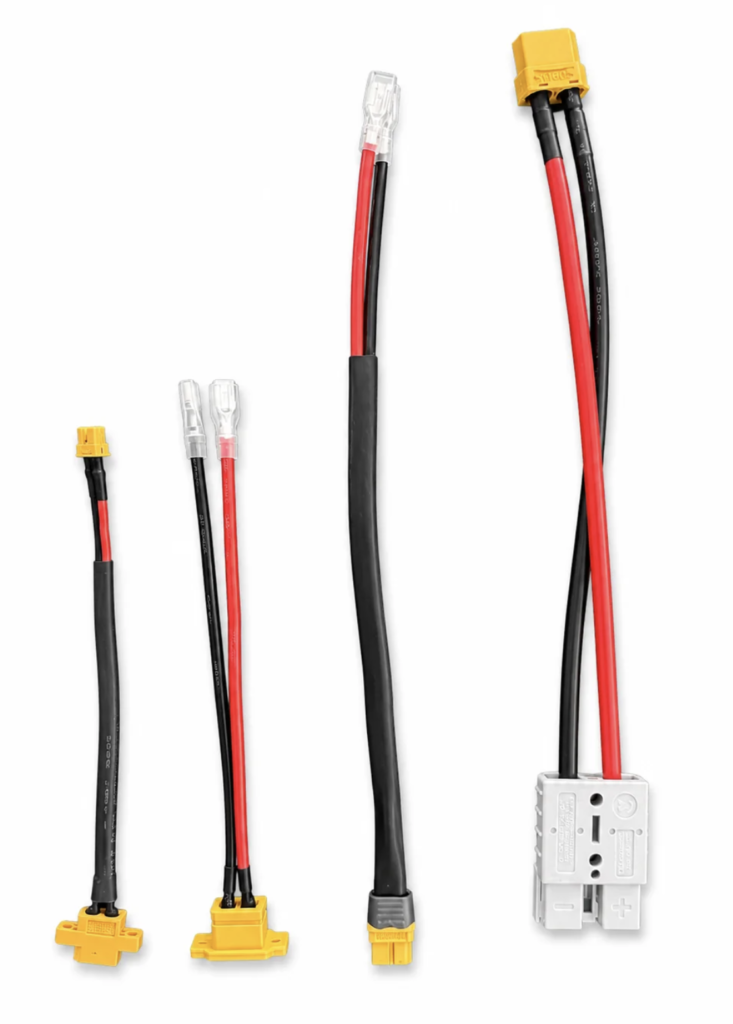
The product shown above is a good example of this approach. It uses red and black conductors for polarity identification and different connector configurations to suit different power connection requirements.
From my experience with custom cable projects, the biggest advantage isn’t simply saving assembly time. It’s making sure the cable is designed around the equipment from the beginning.
What Does a Battery Cable Assembly Include?
A typical battery power cable assembly can include several key components:
1. Power Cable
The cable carries electrical power between the battery and the connected equipment.
Wire gauge, conductor material, insulation and cable length should be selected according to the actual electrical load and installation environment.
For battery-powered equipment, flexible stranded copper conductors are commonly used because the cable may need to move or bend during installation.
2. Power Connector
The connector provides the interface between the battery cable and the equipment.
The product in the image uses yellow high-current style connectors in several configurations. Depending on the application, a custom battery cable may also use other connector families.
The important point is not simply choosing a connector that “looks right.”
The connector needs to match the mating interface, polarity, mechanical fit and electrical requirements of the equipment.
3. Red and Black Polarity Identification
Using red and black wires is a simple but useful design choice.
Red is commonly used for positive and black for negative in DC power wiring. Clear polarity identification makes installation easier and helps reduce wiring mistakes.
For OEM production, consistent color coding can also make assembly and inspection more efficient.
4. Insulation and Protection
The connection area needs appropriate insulation and mechanical protection.
Depending on the design, this may include:
- Heat-shrink tubing
- Insulation sleeves
- Strain relief
- Protective jackets
- Connector housings
- Custom overmolding
The correct protection depends on the application rather than following one universal specification.
Custom Battery Cable Assembly Specifications
One thing I always recommend when specifying a battery cable is to look at the complete assembly, not just the wire.
A cable may have the correct conductor size, but if the connector, termination or cable length isn’t suitable, the finished assembly still won’t perform as expected.
Here are the main specifications I normally review:
| Specification | Typical Options |
|---|---|
| Product Type | Battery Cable Assembly / Power Cable Assembly |
| Cable Configuration | 2-core / multi-core |
| Wire Color | Red / Black / Custom |
| Conductor | Copper / Tinned Copper |
| Wire Gauge | Custom according to application |
| Cable Length | Custom |
| Connector Type | XT Series / High-Current Connector / Custom |
| Connector Configuration | Male / Female / Custom |
| Termination | Crimping / Soldering / Custom |
| Insulation | PVC / Silicone / TPE / Other |
| Heat Shrink | Optional |
| Polarity | Custom / Application-specific |
| Connector Orientation | Straight / Right-angle / Custom |
| Electrical Testing | Continuity / Polarity / Custom |
| Packaging | Bulk / Individual / OEM Packaging |
Important: Current, voltage and temperature ratings should always be confirmed from the selected wire, connector and termination specifications. They should not be assumed simply from the appearance of the cable.
Why Use a Custom Battery Power Cable?
A standard cable can work well for a standard application.
But many OEM products aren’t standard.
The battery may be in a different location. The connector may be positioned differently. The cable may need to pass through a narrow enclosure or follow a specific routing path.
That’s where custom cable assemblies make more sense.
Customized Cable Length
Cable length can be made according to the actual equipment layout.
Instead of leaving extra cable inside the equipment, you can specify the length needed for the installation.
This can help with:
- Cleaner cable routing
- Easier installation
- Reduced cable clutter
- More consistent assembly
Customized Connector Configuration
Different equipment may use different power interfaces.
A custom assembly can be configured with the connector required by the battery, controller, ESC, power distribution board or other equipment.
Commercial custom cable suppliers commonly offer combinations such as XT60, XT90, Anderson-style connectors, ring terminals and other interfaces.
Consistent OEM Production
For OEM applications, consistency is especially important.
If every cable arrives with the same:
- Length
- Wire color
- Connector
- Polarity
- Termination
- Labeling
the assembly process becomes much easier to standardize.
High-Current Battery Cable: What Should You Check?
The phrase high-current battery cable sounds straightforward, but there are several things to consider before choosing one.
Wire Gauge
Wire gauge affects resistance, voltage drop and heat generation.
The correct gauge depends on factors such as:
- Continuous current
- Peak current
- Cable length
- Installation environment
- Conductor material
- Allowable voltage drop
Longer cable runs generally create more resistance, so cable size should be considered together with length rather than independently.
Connector Rating
The connector is another important part of the electrical path.
For example, commercially available XT60 cable assemblies are commonly used for battery and model-aircraft applications, but the exact current and voltage rating depends on the specific connector version and manufacturer.
My practical advice is simple:
Don’t select the cable based on the connector name alone.
Look at the complete electrical path.
Cable Length
Short battery leads are often preferred in compact battery-powered systems because they simplify routing and can help minimize unnecessary resistance.
But the shortest cable isn’t automatically the best cable.
The cable still needs enough length for safe installation without putting mechanical stress on the connector.
Where Are Battery Cable Assemblies Used?
Custom battery power cables are used in a wide range of equipment.
UAV and Drone Systems
Battery cables are an important part of UAV and FPV power systems.
They can connect:
- Battery packs
- ESCs
- Power distribution boards
- Chargers
- Power modules
- Other DC equipment
High-current battery cable assemblies with XT-style connectors are already used commercially for model aircraft and drone battery applications.
For this type of application, cable flexibility, connector compatibility and polarity identification are particularly important.
RC Models
RC aircraft, cars, boats and other battery-powered models often use compact DC power connectors.
A finished battery cable assembly can make battery replacement and equipment integration much easier.
Battery Systems
Battery cables can also be used in:
- Portable power equipment
- Battery packs
- Energy storage systems
- Power distribution equipment
- Charging systems
- Backup power equipment
The exact connector and cable specification should be selected according to the equipment’s electrical and mechanical requirements.
Robotics and Industrial Equipment
Robotics and industrial equipment often have limited installation space.
A custom cable can be designed around the actual equipment instead of forcing a standard cable into an unsuitable routing path.
This is particularly useful when the cable needs a specific:
- Length
- Connector
- Exit direction
- Wire gauge
- Polarity
- Protection method
Custom Battery Cable Assembly for UAV and RC Applications
The product shown in your image is particularly suitable for discussing UAV, RC and battery-powered equipment because the combination of red/black power wires and compact power connectors is typical of this type of application.
But I would avoid putting an exact current rating or wire gauge into the article unless your factory’s actual product specification confirms it.
This is important for a manufacturer website.
I’ve seen many product pages list a cable as “60A” or “100A” simply because the connector is commonly associated with that number. That’s not necessarily enough to establish the rating of the complete cable assembly.
The actual assembly needs to be evaluated as a system:
Connector + conductor + cable length + termination + operating environment.
That’s a much more technically credible way to present the product.
What Can Be Customized?
One of the biggest advantages of working with a custom battery cable assembly manufacturer is flexibility.
Depending on the project, you can customize:
Cable
- Wire gauge
- Cable length
- Wire color
- Conductor material
- Insulation material
- Number of conductors
Connector
- Connector series
- Connector gender
- Connector orientation
- Connector position
- Mating interface
- Connector color
Termination
- Crimped terminals
- Soldered connections
- Ring terminals
- Fork terminals
- Bare/tinned wire ends
- Custom terminals
Protection
- Heat shrink
- Protective sleeve
- Strain relief
- Labeling
- Marking
- Custom overmolding
Commercial custom cable manufacturers also commonly configure connector type, wire gauge, cable length, branching, protection and labeling around the customer’s equipment.
What I’ve Learned From Custom Battery Cable Projects
After working with different wire and cable assemblies, there’s one thing I would always recommend:
Don’t start with the cable. Start with the equipment connection.
Before selecting the wire, confirm:
- What connector is already installed on the equipment?
- What connector does the battery use?
- What is the required cable length?
- What are the continuous and peak current requirements?
- How will the cable be routed?
- Does the cable need to flex?
- Are there any temperature, vibration or environmental requirements?
Once these questions are clear, choosing the wire and connector becomes much easier.
This is also why a good custom cable manufacturer should be able to discuss the complete assembly rather than simply quote a piece of wire.
Battery Cable Assembly vs. Standard Battery Cable
There is a practical difference between buying cable and buying a finished cable assembly.
| Standard Battery Cable | Custom Battery Cable Assembly |
|---|---|
| Cable supplied separately | Finished assembly |
| Connector installed separately | Connector installed |
| Customer handles termination | Factory-controlled termination |
| More installation work | Ready for installation |
| Higher risk of assembly variation | Better production consistency |
| Standard lengths may be limited | Custom length available |
| Limited connector options | Connector can be customized |
For prototypes or one-off repairs, a standard cable may be perfectly adequate.
For OEM production, however, a finished assembly can simplify purchasing and production considerably.
How Is a Custom Battery Cable Assembly Made?
A typical manufacturing process includes:
Step 1: Wire Cutting
The cable is cut to the specified length.
Step 2: Wire Stripping
The insulation is removed according to the required termination length.
Step 3: Connector Preparation
The selected connector and terminals are prepared for assembly.
Step 4: Crimping or Soldering
The conductors are connected to the terminals or connector according to the specified termination method.
Step 5: Insulation Protection
Heat-shrink tubing or other protection can be added where required.
Step 6: Electrical Testing
The finished cable can be checked for continuity and polarity, with additional testing available when required by the application.
Step 7: Final Inspection
The finished assembly is inspected for connector orientation, cable length, appearance, termination quality and other customer requirements.
For OEM production, this process is important because the goal isn’t just to make one cable correctly. The goal is to make the same cable correctly over and over again.
What Should You Send to a Battery Cable Assembly Manufacturer?
You don’t necessarily need a complicated engineering drawing to start a project.
If you have one, that’s ideal.
But even without a formal drawing, the following information is useful:
- Product application
- Battery type
- Connector photos or part number
- Mating connector information
- Wire gauge
- Cable length
- Wire color
- Current requirement
- Voltage requirement
- Connector orientation
- Quantity
- Packaging requirements
- Special environmental requirements
A clear photo of the existing connector can also be extremely helpful when the connector model isn’t known.
How to Choose a Custom Battery Cable Assembly Manufacturer
For OEM purchasing, I would look beyond price.
A reliable supplier should be able to help you confirm:
Connector Compatibility
The connector should match the mating component correctly.
Wire Selection
The supplier should understand the relationship between wire gauge, cable length and electrical load.
Assembly Quality
Crimping, soldering, insulation and connector installation should be consistent.
Testing
Continuity and polarity testing are particularly useful for power cable assemblies.
Customization
The supplier should be able to adjust cable length, connector configuration and other specifications according to your design.
Production Consistency
For larger OEM orders, consistency between batches becomes just as important as the initial sample.
FAQ About Custom Battery Cable Assemblies
What is a battery cable assembly?
A battery cable assembly is a finished power cable with connectors or terminals installed at one or both ends. It is designed to connect a battery or power source to electrical equipment.
Can battery cable assemblies be customized?
Yes. Cable length, wire gauge, wire color, connector type, connector orientation, termination and protective materials can typically be customized according to the application.
Are these cables suitable for drones?
They can be used for UAV and drone power applications when the selected wire, connector and termination meet the electrical and mechanical requirements of the specific system.
Can I customize the connector?
Yes. Connector selection is one of the most common customization requirements for battery cable assemblies.
Can you make cables to a sample?
For a custom manufacturer, a physical sample, connector photo, drawing or specification sheet can be used as a starting point for developing the assembly.
How do I choose the right wire gauge?
Wire gauge should be selected based on the actual current requirement, cable length, allowable voltage drop, conductor material and operating environment. It should not be chosen based only on the connector type.
Final Thoughts
A battery cable assembly may look like a simple product, but the details matter.
The right combination of wire, connector, length, termination and protection can make installation easier, improve production consistency and reduce unnecessary assembly work.
For OEM applications, I usually recommend treating the cable as part of the equipment design rather than as an afterthought.
If you are sourcing custom battery cable assemblies, high-current power cables, UAV battery cables or other custom cable assemblies, the best starting point is to provide the connector requirements, cable length, wire specification and application.
From there, the assembly can be designed around the actual equipment instead of forcing the equipment to work around a standard cable.