
Custom Multi-Connector Wire Harness: Specifications, Ring Terminals & OEM Solutions
SEO Meta Title: Custom Multi-Connector Wire Harness | OEM Manufacturer
Meta Description: Looking for a custom multi-connector wire harness? Explore ring terminals, multi-pin connectors, wire color options and OEM cable assembly solutions for industrial and electronic equipment.
Primary Keyword: custom multi-connector wire harness
Secondary Keywords:
- custom wire harness
- multi-connector wire harness
- wire harness with ring terminals
- custom ring terminal wire harness
- multi-connector cable assembly
- custom electrical wire harness
- OEM wire harness
- custom wire assembly
- multi-pin connector wire harness
- ring terminal wire assembly
- custom cable assembly manufacturer
- wire harness assembly manufacturer
What Is a Custom Multi-Connector Wire Harness?
A custom multi-connector wire harness is a finished wiring assembly that combines multiple wires, terminals and connector types into one organized electrical system.
Instead of installing each wire separately, equipment manufacturers can order a harness that follows their wiring diagram, connector layout and installation requirements.
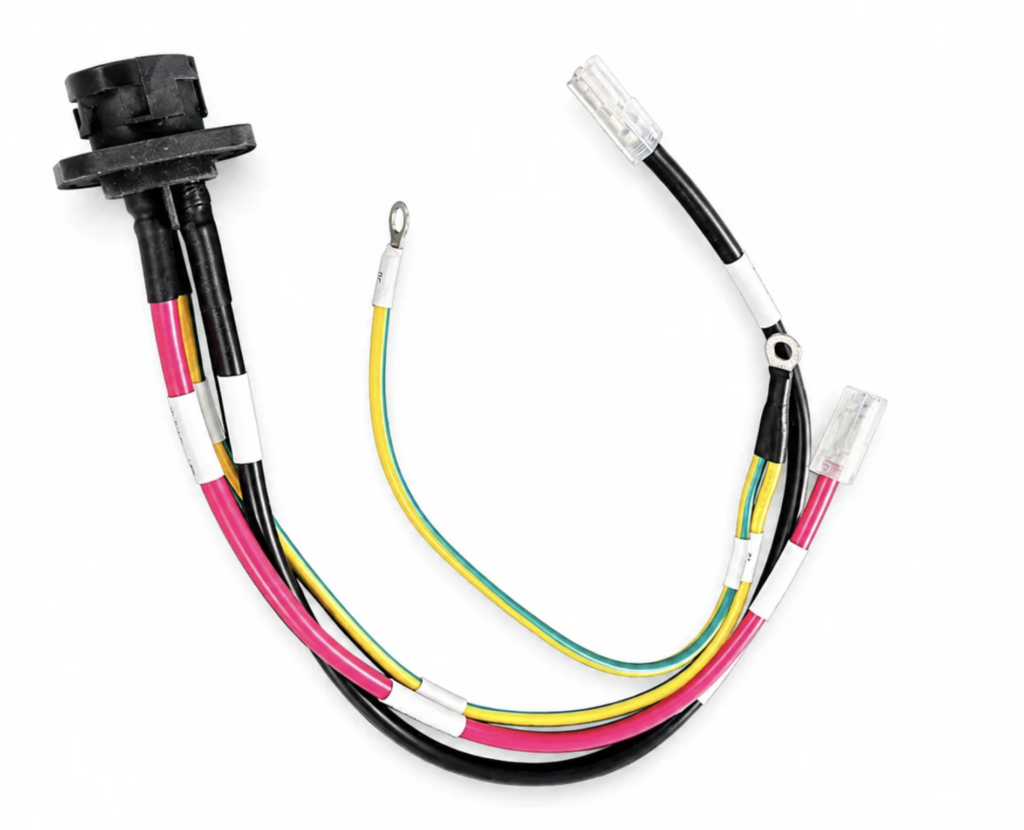
The product shown in the image is a good example of this type of assembly. It includes color-coded wires, ring terminals at several wire ends and multiple connector housings. Some leads are grouped into larger cable sections, while others remain separate for individual connections.
This configuration is useful when a piece of equipment has several connection points that cannot all be served by a single standard connector.
From a manufacturing perspective, the real value is not simply putting several wires together. It is making sure that every connector, terminal, wire color and pin assignment matches the equipment design.
Key Components of a Multi-Connector Wire Harness
A custom harness can look relatively simple from the outside, but each component serves a specific purpose.
1. Electrical Wires
The wires carry power or electrical signals between different parts of the equipment.
As shown in the image, multiple wire colors can be used within the same assembly. Depending on the design, the harness may also combine different wire gauges or insulation types.
When specifying the wires, consider:
- Wire gauge and conductor material
- Insulation material
- Individual wire length
- Color coding
- Electrical load or signal requirements
- Temperature and installation environment
The correct wire specification depends on the application. It should not be estimated from the product photograph alone.
2. Ring Terminals
Several wires in the image have metal ring terminals attached to their ends.
A ring terminal creates a connection point that can be secured using a compatible screw, bolt or stud. It is commonly used where a wire needs to connect to a fixed terminal point.
For a custom wire harness with ring terminals, important details include:
- Ring terminal hole diameter
- Wire gauge compatibility
- Terminal material and plating
- Crimping requirements
- Insulation and strain relief
- Mounting hardware compatibility
One detail I always recommend checking early is the mounting stud size. A ring terminal that fits the wire correctly can still be unsuitable if its mounting hole does not match the equipment.
3. Multi-Pin Connectors
The image also shows several colored connector housings at the ends of the larger cable sections.
Multi-pin connectors allow several circuits to connect through one mating interface. They can simplify installation compared with connecting each wire individually.
The exact connector series and pin count cannot be confirmed from this photograph alone. For production, the connector part number, mating connector or approved drawing should be used to confirm compatibility.
4. Cable Grouping and Protection
The thicker black cable sections appear to group or protect multiple conductors.
Depending on the actual construction, a harness may use an outer jacket, protective sleeve, wrapping or other cable-management materials.
These features can help organize the wiring and protect it during installation. The appropriate construction depends on the required flexibility, abrasion resistance and operating environment.
Custom Multi-Connector Wire Harness Specifications
The following table provides a practical starting point for an OEM wire harness specification.
| Specification | Available Options |
|---|---|
| Product Type | Custom Multi-Connector Wire Harness |
| Wire Configuration | Multiple wires / Multiple connector branches |
| Wire Gauge | Customized |
| Conductor Material | Copper / Tinned Copper |
| Wire Colors | Black, Red, Yellow, Blue, White and other custom colors |
| Cable Length | Customized |
| Connector Type | Multi-pin connectors / Customer-specified connectors |
| Connector Quantity | Based on design |
| Pin Configuration | Defined by wiring diagram |
| Terminal Type | Ring terminals / Crimp contacts / Other specified terminals |
| Ring Terminal Hole Size | Customized to mounting requirements |
| Insulation | PVC / Silicone / TPE / Other suitable materials |
| Cable Protection | Jacket / Sleeving / Wrapping / Heat shrink |
| Wire Identification | Color coding / Labels / Marking |
| Electrical Testing | Continuity / Pinout verification / Other specified tests |
| Packaging | Bulk / Individual / OEM packaging |
These are customization options, not verified specifications for the exact product in the photograph. Final materials, dimensions, electrical ratings and connector models should be confirmed against the actual design.
Why Use a Custom Multi-Connector Wire Harness?
For equipment manufacturers, a custom harness can simplify the process of connecting multiple electrical interfaces.
The advantage becomes more obvious when a product uses different connector families or requires both plug-in connectors and screw-mounted terminals.
One Assembly, Multiple Connection Types
A single harness can combine different connector interfaces and terminal styles according to the equipment layout.
For example, one branch might terminate in a multi-pin connector, while another uses a ring terminal for a fixed mounting point.
This reduces the need to source and manage every individual wire as a separate component during final assembly.
Easier Equipment Installation
When wire lengths, connector positions and terminal types are defined in advance, the harness can be installed according to the intended layout.
This can reduce manual wiring work and make assembly more repeatable.
Better Wire Identification
Color-coded wires can make individual circuits easier to distinguish.
For OEM projects, the color sequence should follow the approved wiring diagram. If labels or wire markers are needed, they can also be included in the specification.
More Consistent Production
Once the wiring configuration has been approved, the same design can serve as the reference for repeat orders.
For manufacturers producing multiple units, this helps standardize connector selection, pin mapping, wire length and termination.
How to Choose the Right Ring Terminals and Connectors
Connector selection is one of the most important parts of designing a multi-connector wire harness.
The wrong connector can prevent installation, while an incorrect pin assignment can create an electrical fault.
Match the Connector to the Mating Interface
Start with the connector already installed on the equipment.
Confirm its part number, series, pin count and mating requirements. If the part number is unavailable, provide a clear photograph of both the connector and its mating interface.
Don’t rely on color or external appearance alone. Different connector families can look similar while having different internal configurations.
Select the Correct Ring Terminal
For ring terminal leads, check the wire gauge and mounting hole size together.
Also consider the terminal material, plating and termination method. The final terminal should fit both the conductor and the equipment mounting point.
Confirm the Pinout
A connector with the correct number of positions is not necessarily wired correctly for your application.
The pin-to-pin mapping should be documented and checked before production. This is especially important when a harness combines several connectors and individual terminal leads.
Consider Installation Space
Connector orientation and wire exit direction can affect how easily a harness fits into the equipment.
If the space is restricted, provide the manufacturer with the relevant dimensions or an installation photograph.
My practical advice: confirm the mating interface and pinout before finalizing the cable layout. These details are more important than simply choosing a connector that looks similar to the original.
Applications of Custom Multi-Connector Wire Harnesses
This type of harness can be considered for equipment that requires several different electrical interfaces within one wiring assembly. The actual application depends on the connector system and electrical requirements.
Industrial Equipment
Industrial machinery may contain sensors, controllers, switches, power connections and other electrical components.
A custom harness can combine these connection points into one organized assembly.
Electrical Control Systems
Control equipment may require a combination of multi-pin connectors and terminal connections.
A harness built around the wiring diagram can help keep the installation consistent and simplify later maintenance.
Electronic Equipment
Electronic products often have limited internal space and several connection interfaces.
Custom wire lengths, connector positions and wire identification can help the assembly fit the intended enclosure.
Automotive and Mobility Equipment
Some automotive and mobility applications use wiring assemblies with multiple connectors and ring-terminal connections.
These applications may require additional attention to vibration, temperature, routing and environmental protection.
OEM Equipment and Replacement Assemblies
A custom multi-connector harness can also be useful when reproducing an existing wiring assembly.
A sample, drawing or connector specification can help establish the required configuration, provided that the wiring and pin assignments are confirmed before production.
These are potential application categories for the product type, not confirmed end uses of the exact pictured harness.
What Can Be Customized?
A key benefit of working with a custom wire harness manufacturer is the ability to configure the assembly around your product.
Wire and Cable Options
- Wire gauge
- Wire color
- Conductor material
- Individual wire length
- Main cable length
- Insulation material
- Number of conductors
Connector and Terminal Options
- Connector series and part number
- Connector quantity
- Pin count and pin assignment
- Ring terminal type and hole size
- Crimp contact type
- Connector orientation
- Combination of different connection interfaces
Protection and Identification
- Protective sleeving
- Outer cable jacket
- Heat-shrink tubing
- Strain relief
- Labels and wire markers
- Custom packaging
Not every option is suitable for every design. The final configuration should be reviewed against the equipment requirements and the selected components.
What I’ve Learned From Custom Wire Harness Projects
One issue that deserves more attention is the difference between a harness that looks correct and one that is electrically correct.
Two assemblies can have similar wire colors, connector housings and terminal styles, yet have different pin assignments.
For this reason, I would never use a product photograph as the only reference for a multi-connector harness.
Before production, I recommend confirming three things:
First, the physical configuration. Check connector compatibility, wire lengths and terminal sizes.
Second, the electrical configuration. Confirm every pin assignment and wire-to-terminal connection against the approved diagram.
Third, repeatability. Make sure the approved sample or drawing clearly defines the assembly so that future orders can follow the same specification.
This approach helps prevent avoidable mistakes and makes communication between the customer and manufacturer much more straightforward.
Custom Multi-Connector Wire Harness vs. Standard Wire Assembly
| Standard Wire Assembly | Custom Multi-Connector Wire Harness |
|---|---|
| May connect one or two interfaces | Can combine multiple connection interfaces |
| Often has a simpler wiring layout | Can include different connector and terminal types |
| Standard configuration may be limited | Wire routing and pinout can be customized |
| May require additional wiring during installation | Can arrive as a predefined assembly |
| Limited branch arrangements | Can accommodate multiple branches and connection points |
The distinction is not absolute because the terms wire assembly, cable assembly and wire harness overlap in the industry. What matters most is the actual configuration and the requirements of the equipment.
How Is a Custom Multi-Connector Wire Harness Manufactured?
A typical manufacturing process includes the following steps.
1. Wire Cutting and Stripping
The wires are cut to the specified lengths, and insulation is removed according to the terminal or connector requirements.
2. Terminal Crimping
Ring terminals and other specified contacts are attached using the required termination process.
3. Connector Assembly
The contacts are installed into the designated connector cavities according to the approved pinout.
4. Harness Organization
The wires are grouped and arranged according to the intended routing, connector layout and branch lengths.
5. Protective Processing
Sleeving, wrapping, heat-shrink tubing or labels can be added where required by the design.
6. Electrical Testing and Final Inspection
Depending on the specification, checks may include continuity, pinout verification, connector position, wire length and visual inspection.
For OEM production, the objective is not just to produce one correctly assembled harness. It is to reproduce the approved configuration consistently across orders.
What Should You Send to a Custom Wire Harness Manufacturer?
You don’t always need a complete engineering drawing to start a project. A physical sample or clear photographs can be a useful starting point.
For a quotation, try to provide:
- Product application
- Number and type of connectors
- Connector part numbers, if available
- Pin count and pinout
- Number of wires
- Wire gauge and color
- Main cable and individual wire lengths
- Ring terminal specifications
- Protective sleeving requirements
- Electrical and environmental requirements
- Estimated order quantity
- Drawing or physical sample, if available
If some details are unknown, send the sample and explain what the harness needs to connect. The missing specifications can then be identified during technical review.
How to Choose a Custom Wire Harness Manufacturer
When sourcing a custom multi-connector wire harness, I would look beyond the initial quotation.
A suitable manufacturer should be able to help you confirm:
- Connector compatibility: The connector and mating interface are correctly identified.
- Pinout accuracy: The wiring follows the approved diagram.
- Termination quality: Crimping and terminal installation meet the specified requirements.
- Customization capability: Wire colors, lengths, connectors and terminals can be configured for the project.
- Testing and inspection: The supplier can explain which checks are included.
- Production consistency: The approved sample or drawing can be used as a reference for repeat orders.
Clear communication about these details can make a significant difference, particularly when the harness is part of a larger OEM product.
Frequently Asked Questions
What is a multi-connector wire harness?
It is a finished wiring assembly that combines multiple wires and connector interfaces into one organized unit. Depending on the design, it may include ring terminals, multi-pin connectors and different wire lengths.
Can a wire harness combine ring terminals and multi-pin connectors?
Yes. A custom assembly can use different terminal and connector types on separate wires or branches, provided that the components and wiring layout are compatible with the intended application.
Can wire colors and lengths be customized?
Yes. Wire colors, individual lead lengths, main cable length and other configuration details can generally be specified according to the approved design.
How do I confirm the correct connector?
Provide the connector part number, mating connector information, drawing or a clear photograph. Visual appearance alone may not be enough to identify the exact connector series.
Can a custom wire harness be manufactured from a sample?
A sample can be used as a starting reference. Before production, the manufacturer should confirm the wiring configuration, connector details and electrical requirements rather than assuming all specifications from appearance.
What testing is recommended for a multi-connector harness?
Continuity and pinout verification are common checks. Additional testing depends on the electrical requirements, connector system and customer specification.
Final Thoughts
A custom multi-connector wire harness is designed to bring different electrical connection points together in one organized assembly.
By combining multi-pin connectors, ring terminals, color-coded wires and customized cable lengths, manufacturers can create a wiring solution that fits the equipment rather than relying on several separately installed wires.
For OEM projects, the most important details are connector compatibility, pinout accuracy, termination quality and repeatable production.
If you’re sourcing a custom multi-connector wire harness, wire harness with ring terminals or OEM cable assembly, start with your connector details, wiring diagram or existing sample. These provide a practical foundation for developing the right assembly for your equipment.
Looking for a custom wire harness for your next project? Share your drawing, sample or basic requirements to discuss a suitable configuration and request a quotation.