
SEO Article
Custom Wire Assembly: Types, Specifications, Applications & Manufacturing
SEO Meta Title
Custom Wire Assembly Manufacturer | OEM Wire & Cable Solutions
Meta Description
Looking for a custom wire assembly? Explore wire gauges, terminals, connectors and cable options for battery, industrial, automotive and electronic applications.
Primary Keyword
custom wire assembly
Secondary / Related Keywords
- custom wire assembly manufacturer
- custom wire harness
- custom cable assembly
- electrical wire assembly
- wire assembly
- battery cable assembly
- connector wire assembly
- ring terminal wire assembly
- pre-crimped wire assembly
- custom wiring solutions
- wire harness assembly
- OEM wire assembly
Custom Wire Assembly: Types, Specifications, Applications & Manufacturing
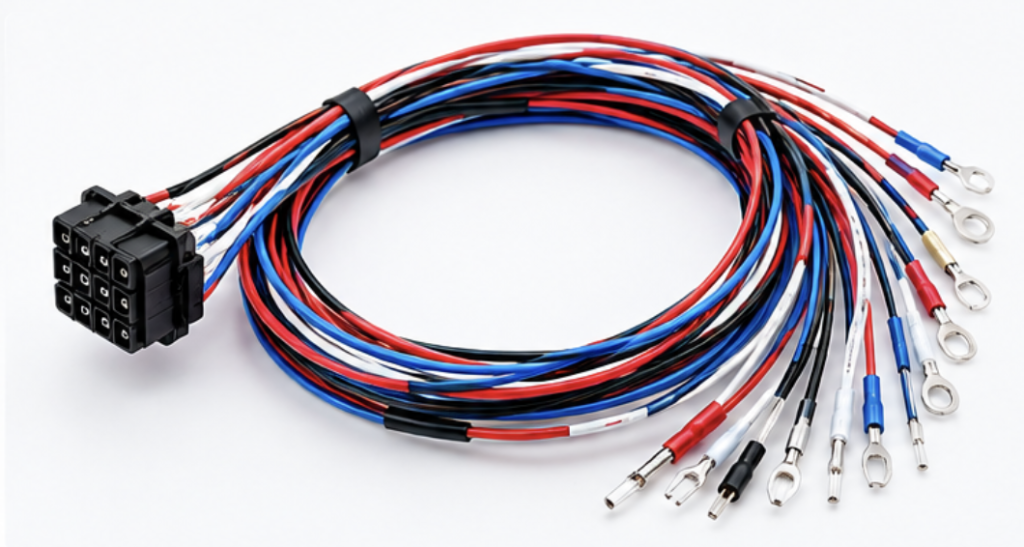
If you have ever had to install loose wires by hand, you already know how quickly a simple wiring job can become time-consuming.
You have to cut the wire, strip the insulation, choose the right terminal, crimp it properly, route everything into position, and then check whether the connections are correct.
That is where a custom wire assembly can make a real difference.
Instead of sending customers a spool of wire and leaving the final assembly work to them, a custom wire assembly can arrive ready to install—with the required wire length, terminals, connectors, insulation, and configuration already prepared.
From a manufacturing and engineering perspective, the real value is not simply saving a few minutes of wiring work. It is getting the electrical connection configured around the actual equipment.
This guide takes a practical look at custom wire assemblies, including their types, specifications, applications, manufacturing process, and the information you should prepare when working with a manufacturer.
What Is a Custom Wire Assembly?
A custom wire assembly is a prepared electrical connection made from one or more wires combined with terminals, connectors, or other components.
Unlike standard wire sold by the roll or meter, a custom wire assembly is manufactured according to a specific application or installation requirement.
Depending on the project, an assembly may include:
- Electrical wire or cable
- Ring terminals
- Fork or spade terminals
- Blade terminals
- Electrical connectors
- High-current connectors
- Heat-shrink tubing
- Protective sleeves
- Other insulation or protection components
The configuration can be relatively simple, such as a single wire with a terminal on one end, or more complex, with multiple wires and connectors.
The basic idea is straightforward:
Instead of assembling the wiring yourself, you receive a finished electrical connection that is ready for installation.
That can be particularly useful for OEM production, electrical equipment, battery systems, and applications where consistent wiring is important.
Types of Custom Wire Assemblies
There is no single “standard” custom wire assembly.
The right configuration depends on how the wire will be connected, what equipment it will be installed into, and what electrical and mechanical requirements need to be met.
Here are some common configurations.
1. Ring Terminal Wire Assembly
A ring terminal wire assembly uses a circular terminal at one or both ends of the wire.
The terminal can typically be secured using a screw, bolt, or stud.
This makes ring terminal assemblies a practical choice for applications such as:
- Battery connections
- Grounding
- Power distribution
- Industrial equipment
- Electrical control systems
One detail that is easy to overlook is the terminal hole size.
The ring needs to match the mounting stud or screw, while the terminal barrel also needs to match the selected wire size. Getting either dimension wrong can create installation problems.
That is why ring terminal diameter, wire gauge, cable length, and terminal type should be confirmed before production.
2. Fork Terminal Wire Assembly
Fork or spade terminals have an open-ended connection design.
Compared with a fully closed ring terminal, the open design can make installation or removal more convenient in certain applications.
A fork terminal wire assembly can be customized according to:
- Wire gauge
- Terminal size
- Cable length
- Insulation
- Terminal material or finish
- Installation requirements
They can be useful in electrical equipment where wiring may need to be disconnected during maintenance.
3. Connector Wire Assembly
A connector wire assembly combines one or more wires with a specified electrical connector.
This is one of the more flexible configurations because the connector can be selected around the mating component and electrical requirements.
Depending on the application, configurations may include:
- DC power connectors
- Battery connectors
- High-current connectors
- Automotive connectors
- PCB connectors
- Custom electrical connectors
One thing I would always recommend is confirming the mating connector or connector part number before production.
A connector can look almost identical to another model while having a different pin arrangement, terminal configuration, or mating interface.
For OEM projects, connector identification is therefore just as important as wire selection.
4. Battery Cable Assembly
A battery cable assembly is designed to connect batteries with other electrical components.
Typical applications include:
- Battery packs
- Backup power systems
- Mobile equipment
- Electric equipment
- DC power systems
- Energy storage equipment
Battery cable assemblies can be configured with different wire gauges, terminal types, connectors, and cable lengths.
For these applications, wire size should not be selected based on appearance alone. Current requirements, cable length, temperature, connector specifications, and the overall electrical design all need to be considered.
5. Pre-Crimped Wire Assembly
A pre-crimped wire assembly is supplied with the required terminal already attached to the wire.
This is particularly useful when the customer wants to simplify its own production process.
Instead of receiving loose wire and terminals and performing crimping in-house, the customer can install the prepared assembly directly into the equipment or production line.
For manufacturers using thousands of wiring components, this can also help create a more consistent assembly process.
Key Specifications of a Custom Wire Assembly
When discussing a custom wire assembly with a manufacturer, the product name alone usually isn’t enough.
A good specification needs to define the details that actually affect the electrical connection and installation.
Here are the main items to consider.
Wire Gauge
Wire gauge determines the approximate conductor size and is one of the first specifications to confirm.
Depending on the application, a custom wire assembly may use different wire gauges, including:
- 10 AWG
- 12 AWG
- 14 AWG
- 16 AWG
- 18 AWG
- Other customized sizes
The correct gauge depends on factors such as:
- Required current
- Voltage
- Cable length
- Operating temperature
- Installation environment
- Applicable electrical requirements
In other words, AWG should be selected based on the application—not simply because a particular size is commonly used.
Conductor Material
Copper is widely used because it provides good electrical conductivity while remaining flexible enough for many wiring applications.
Common options can include:
- Bare copper
- Tinned copper
- Other application-specific conductor configurations
Tinned copper can be useful where additional resistance to oxidation and environmental exposure is needed.
The right choice depends on the operating environment and the customer’s electrical requirements.
Cable Length
Cable length sounds simple, but it is one of the specifications that can have a noticeable impact on installation.
With a custom wire assembly, the finished length can be specified during production instead of purchasing an oversized standard cable and cutting it during installation.
A properly specified cable length can help:
- Simplify installation
- Reduce excess wire
- Improve cable routing
- Reduce manual processing
- Keep production more consistent
For OEM applications, I would recommend providing the finished assembly length and measurement method rather than simply saying “about 500 mm.”
Insulation Material
The insulation protects the conductor and provides electrical isolation.
Depending on the application, options may include:
- PVC
- Silicone
- Other application-specific materials
The insulation should be selected according to factors such as:
- Operating temperature
- Flexibility
- Environmental exposure
- Voltage requirements
- Mechanical conditions
For example, an assembly used in a flexible installation may have different insulation requirements from one installed inside a fixed industrial control cabinet.
Wire Color
Wire color can be used to identify polarity or distinguish different circuits.
Common conventions include:
- Red — commonly used for positive power
- Black — commonly used for negative or ground
- Other colors — used for circuit identification
However, color conventions should always follow the actual electrical system design.
For multi-wire assemblies, consistent color coding can make installation and troubleshooting considerably easier.
Terminal and Connector Options
One of the biggest advantages of a custom wire assembly is flexibility.
The wire does not have to be designed around whatever terminal or connector happens to be available. Instead, the assembly can be configured around the actual mating component.
Common terminal options include:
- Ring terminals
- Fork terminals
- Spade terminals
- Blade terminals
- Butt terminals
- Custom terminals
Connector options may include:
- DC power connectors
- Battery connectors
- High-current connectors
- Automotive connectors
- Custom connectors
The important point is that the terminal or connector needs to match the rest of the assembly.
Wire size, electrical load, connector interface, terminal dimensions, and installation method should all be considered together.
Where Are Custom Wire Assemblies Used?
Custom wire assemblies are found in a surprisingly wide range of equipment.
The reason is simple: almost every electrical system has its own combination of wire length, connection points, terminals, and installation requirements.
Battery Systems
Battery systems often require customized connections between:
- Battery cells
- Battery packs
- Terminals
- Protection circuits
- Power distribution components
A battery cable assembly can be configured with the required cable length, terminal and connector combination.
Industrial Equipment
Industrial equipment may contain motors, sensors, controllers, switches, power supplies, and other electrical components.
Using prepared wiring can make production easier because the same cable configuration can be installed repeatedly.
For equipment manufacturers, consistency can be just as important as the wire itself.
Power Distribution Systems
Power distribution applications may require different wire gauges and terminal configurations depending on the electrical load and connection method.
A custom electrical wire assembly can be manufactured with a specified length and connection configuration, helping reduce unnecessary wiring work during installation.
Automotive Electronics
Automotive electronics rely heavily on wires and connectors for:
- Power
- Control
- Lighting
- Sensors
- Electronic modules
Custom assemblies can be designed around specific connector and installation requirements.
For automotive-related projects, connector compatibility and mechanical fit are particularly important.
UAV and RC Systems
Custom wire assemblies can also be used in UAV and RC equipment.
For example, they may be used for:
- Battery connections
- Electronic controllers
- Power distribution
- Internal electrical connections
A specialized drone power cable is a separate product category, but some UAV systems also use customized wire assemblies for internal connections.
The wire gauge, connector, terminal, and cable length can all be selected according to the system design.
Electronic Equipment
Electronic equipment often has limited internal space, which means cable length, connector size, and wire routing matter.
A custom wire assembly can be built around the actual equipment layout instead of forcing the equipment manufacturer to adapt its design around an off-the-shelf cable.
How Is a Custom Wire Assembly Manufactured?
A professional wire assembly manufacturer will typically follow several controlled production steps.
1. Wire Cutting
The wire is cut to the specified finished length.
For production orders, consistent cutting is important because cable length directly affects installation.
2. Wire Stripping
A specified section of insulation is removed without damaging the conductor.
The stripping length needs to match the terminal or connector requirements.
3. Terminal Crimping
The selected terminal is attached to the stripped conductor using the appropriate crimping process.
This is one of the most important steps in the assembly.
A good crimp needs to provide both electrical contact and mechanical stability.
4. Connector Assembly
If the product uses a connector, the wires and terminals are assembled according to the required connector configuration and pin arrangement.
5. Insulation and Protection
Depending on the application, the assembly may include:
- Heat-shrink tubing
- Protective sleeves
- Other insulation components
These can provide additional electrical and mechanical protection.
6. Electrical Testing
Depending on customer requirements, finished assemblies can be checked for:
- Electrical continuity
- Connection integrity
- Pin configuration
- Other specified electrical characteristics
7. Final Inspection
The completed assemblies can then be inspected for:
- Appearance
- Dimensions
- Terminal position
- Connector configuration
- Cable length
- Customer-defined requirements
The exact inspection and testing process should be agreed upon before production.
What Should You Send to a Custom Wire Assembly Manufacturer?
This is one area where a little preparation can save a lot of back-and-forth.
If you are requesting a quotation, try to provide as much of the following information as possible.
1. Wire Gauge
For example, specify the required AWG or conductor size.
2. Cable Length
Give the required finished length and, ideally, explain how the length should be measured.
3. Terminal Type
Specify whether you need:
- Ring terminal
- Fork terminal
- Blade terminal
- Butt terminal
- Other terminal
4. Connector Type
If a connector is required, provide the connector model or mating connector information whenever possible.
5. Wire Color
Specify the required color or polarity identification.
6. Insulation
Provide your preferred insulation material or the operating conditions that the insulation needs to handle.
7. Electrical Requirements
Provide the expected voltage and current requirements.
This helps the manufacturer determine the appropriate wire and connection configuration.
8. Quantity
For production projects, provide the estimated quantity and expected production schedule.
9. Drawing or Sample
If you have a technical drawing, wiring diagram, sample, or existing assembly, providing it can make the quotation process much more straightforward.
For custom projects, a clear drawing or sample is often more useful than a long product description.
What I’ve Learned About Custom Wire Assembly Projects
From a practical manufacturing perspective, the wire itself is often not the difficult part.
The details around the wire are usually where problems appear.
For example, a customer may know that they need a 500 mm cable, but there can still be questions:
- Is the 500 mm measured end-to-end?
- Does it include the terminal?
- What connector is required?
- Which side is positive?
- What is the pinout?
- What terminal hole size is needed?
- Does the wire need to be tinned?
- Is heat shrink required?
- How should the finished assembly be tested?
These details may look small, but they can make a big difference when an assembly goes into production.
My practical advice is simple: define the connection before defining the cable.
In other words, start with the actual equipment interface and work backward to the wire, terminal, connector, length, and insulation.
That approach usually makes the engineering discussion much clearer.
Custom Wire Assembly vs. Wire Harness
These two terms are sometimes used interchangeably, but they can describe slightly different products.
A wire assembly generally refers to a prepared electrical connection consisting of wires with terminals or connectors.
A wire harness often refers to a more organized group of wires that may include multiple branches, connectors, protective coverings, routing features, and other components.
There is also some overlap between the two terms, and terminology can vary between manufacturers and industries.
So when requesting a quotation, I recommend focusing less on the name and more on the actual configuration you need.
A drawing, sample, connector specification, or wiring diagram can remove much of the ambiguity.
Why Use a Custom Wire Assembly?
There are several practical reasons manufacturers choose customized wiring instead of assembling everything themselves.
Ready-to-Install
Terminals and connectors can already be attached when the assembly arrives.
Flexible Configuration
Wire gauge, length, color, insulation, terminals, connectors, and other details can be customized.
Easier Production
Pre-assembled wiring can help standardize connections across repeated production.
Less Manual Work
Your production team may not need to cut, strip, and crimp individual wires during final assembly.
Designed Around Your Equipment
Instead of modifying your equipment to fit an off-the-shelf cable, the cable can be designed around the equipment’s actual requirements.
For OEM manufacturers, that last point is often the most important.
Choosing a Custom Wire Assembly Manufacturer
When selecting a custom wire assembly manufacturer, don’t look only at the unit price.
For a production project, it is also worth confirming whether the supplier can support:
- Required wire gauges
- Cable lengths
- Terminal types
- Connector configurations
- Insulation options
- Crimping requirements
- Electrical testing
- Quality inspection
- Packaging
- Production quantities
For a new project, you can typically provide a drawing, sample, connector model, wire specification, or application requirements.
The manufacturer can then review the information and develop the corresponding custom cable assembly.
For OEM projects, this technical communication is often just as important as the manufacturing capability itself.
Frequently Asked Questions
What is a custom wire assembly?
A custom wire assembly is a prepared electrical connection made from one or more wires with terminals, connectors, or other components according to specific application requirements.
Can a wire assembly be customized?
Yes. Common options include wire gauge, cable length, color, terminal type, connector type, insulation material, and overall assembly configuration.
What terminals can be used?
Depending on the application, a custom wire assembly may use ring terminals, fork terminals, blade terminals, butt terminals, or other terminal configurations.
Can both ends of the wire be assembled?
Yes. An assembly can have a terminal or connector on one end, or different terminals or connectors on both ends.
Can custom wire assemblies be used for high-current applications?
They can be designed for power applications, but the actual current capability depends on the selected wire, conductor size, terminal, connector, insulation, cable length, temperature, and applicable specifications.
The current rating should not be determined from the appearance of the cable alone.
Final Thoughts
A good custom wire assembly is more than just a piece of wire with a connector attached.
It is a small but important part of the overall electrical system, and the details—wire gauge, cable length, terminal, connector, insulation, pinout, and testing—need to work together.
Whether you need a simple ring terminal wire assembly, a battery cable assembly, a pre-crimped wire assembly, or a more complex custom wire harness, the basic principle remains the same:
Build the wiring around the application, rather than trying to force the application to fit a standard cable.
If you are looking for a custom wire assembly manufacturer, providing the wire specification, finished length, terminal or connector information, electrical requirements, quantity, and application details is a good starting point for getting an accurate quotation.